
Revenue vs Profit vs Cash Flow: Spot the Numbers That Really Matter
Revenue, profit, and cash flow are among the most commonly discussed financial terms, yet they are also the most frequently misunderstood. Many people assume that rising revenue means a business is successful, or that profit automatically guarantees financial stability. In reality, these three metrics tell very different stories. Understanding revenue vs profit vs cash flow is essential for anyone analyzing a company’s performance, whether as an investor, business owner, or student of finance.
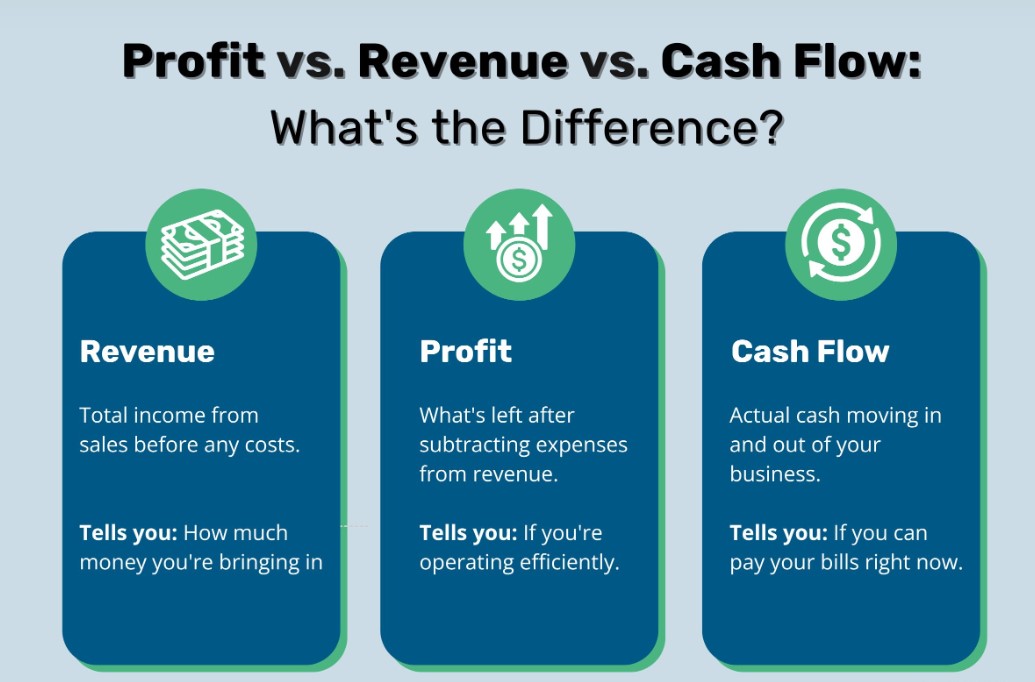
Each metric answers a different question. Revenue shows how much money a business brings in. Profit reveals how much remains after expenses. Cash flow shows whether money is actually moving in and out of the business. Looking at only one can create a distorted picture. This guide explains how these measures differ, how they interact, and why all three matter when assessing financial health.
Revenue Explained Beyond the Surface
Revenue represents the total amount of money a company earns from its core operations. It is often referred to as sales or top-line income. Revenue is recorded when a product is sold or a service is delivered, not necessarily when cash is received.
This distinction matters because revenue reflects activity, not liquidity. A company can report high revenue while struggling to collect payments. That is why revenue alone does not reveal financial strength. It simply shows demand and scale.
When comparing revenue vs profit vs income, revenue sits at the starting point of the financial statement. Everything else flows from it, but it should never be analyzed in isolation.
Profit and Its Many Meanings
Profit represents what remains after expenses are deducted from revenue. It reflects efficiency and cost management rather than pure activity. However, profit itself comes in several forms, which adds to the confusion.
Gross profit focuses on production costs. Operating profit considers operating expenses. Net profit includes taxes, interest, and non-operating items. When people casually refer to profit, they usually mean net profit, but that assumption can lead to misunderstanding.
In the comparison of revenue vs profit vs income, profit and income are often used interchangeably. While closely related, income usually refers to the bottom-line figure after all expenses. Understanding this nuance is essential when evaluating performance.
Cash Flow as the Reality Check
Cash flow measures the actual movement of money into and out of a business. Unlike revenue and profit, it focuses on timing and liquidity. Cash flow answers a critical question: does the business have enough cash to operate, invest, and survive?
A company can be profitable yet run out of cash if payments are delayed or expenses require upfront funding. This is why cash flow vs profit is one of the most important comparisons in financial analysis.
Cash flow reflects reality more directly than accounting-based metrics. It shows whether earnings are translating into usable funds.
Revenue vs Cash Flow: Activity Versus Liquidity
The comparison of revenue vs cash flow highlights the difference between earning and collecting. Revenue records sales activity, while cash flow reflects actual cash received.
For example, a business may sell products on credit. Revenue increases immediately, but cash flow may lag until customers pay. If delays become excessive, the business may struggle despite strong revenue.
This distinction explains why growing companies often face cash shortages. Revenue growth without cash discipline can create financial stress rather than stability.
Cash Flow vs Profit: Timing Changes Everything
Cash flow vs profit is one of the most misunderstood relationships. Profit includes non-cash items such as depreciation and accruals. Cash flow strips those away and focuses on real money movement.
A company may report high profit while cash flow remains weak due to inventory buildup or delayed receivables. Conversely, a business may show low profit but strong cash flow due to upfront customer payments.
Understanding this difference helps prevent false confidence based solely on income statements.
Revenue vs Profit vs Income: Clarifying the Language
Revenue vs profit vs income often confuses readers because the terms are sometimes used loosely. Revenue is the starting figure. Profit represents what remains after expenses. Income usually refers to net profit after all deductions.
Using these terms interchangeably can distort analysis. Clear definitions allow accurate comparison across companies and time periods.
Precise language supports better financial judgment.
Revenue vs Profit vs Cash Flow Examples in Real Business Scenarios
Revenue vs profit vs cash flow examples help illustrate why these metrics diverge. Consider a company that experiences rapid sales growth. Revenue rises sharply. However, to support growth, the company hires staff, invests in inventory, and extends credit to customers.
Profit may remain thin due to rising costs. Cash flow may turn negative as expenses occur before cash is collected. Despite impressive revenue, financial pressure builds.
This example shows why all three metrics must be evaluated together to understand performance fully.
Why Businesses Can Fail Despite Strong Revenue
Many businesses fail not because they lack revenue, but because they lack cash. Revenue alone does not pay bills. Cash does.
High-growth companies often reinvest heavily, stretching cash reserves. If external funding slows or expenses rise unexpectedly, liquidity problems emerge. This highlights the importance of cash flow management alongside revenue generation.
Understanding revenue vs cash flow prevents overconfidence in surface-level success.
Using a Revenue vs Profit vs Cash Flow Calculator
A revenue vs profit vs cash flow calculator helps visualize how money moves through a business. By adjusting inputs such as expenses, margins, and payment timing, users can see how changes affect profitability and liquidity.
Calculators simplify complex relationships but should not replace understanding. They are most effective when used to test scenarios rather than predict outcomes.
The value lies in insight, not automation.
Revenue vs Profit vs Cash Flow PDF Learning Resources
Many learners search for revenue vs profit vs cash flow pdf explanations because the topic benefits from structured breakdowns. While static formats help with study, true understanding comes from applying concepts to real situations.
Reading definitions builds awareness, but analyzing real financial statements builds skill. Context transforms theory into judgment.
Learning improves when concepts are revisited through practice.
Gross Revenue vs Cash Flow Calculator Thinking
Gross revenue vs cash flow calculator comparisons highlight how misleading top-line figures can be. Gross revenue ignores costs, timing, and cash availability. Cash flow reflects operational reality.
Using these comparisons helps identify businesses that grow responsibly versus those expanding unsustainably. Gross revenue alone never tells the full story.
Healthy businesses balance growth with liquidity.
Revenue to Cash Flow Ratio and What It Signals
The revenue to cash flow ratio measures how efficiently revenue converts into cash. A lower ratio often indicates strong collection and operational efficiency. A high ratio may suggest delays or working capital strain.
This ratio helps analysts assess quality of earnings. Revenue that consistently converts into cash is more valuable than revenue that remains locked in receivables.
Ratios add depth when interpreted thoughtfully.
Why Investors Focus More on Cash Flow Over Time
Long-term investors often prioritize cash flow because it supports dividends, reinvestment, and debt repayment. Profit can fluctuate due to accounting changes, but cash flow reveals sustainability.
When evaluating revenue vs profit vs cash flow, experienced investors ask whether profits are backed by cash. Without that support, earnings quality is questionable.
Cash flow builds confidence in long-term outcomes.
Common Misinterpretations That Lead to Poor Decisions
One common mistake is assuming revenue growth guarantees success. Another is believing profit alone ensures stability. Ignoring cash flow often leads to surprises.
Businesses that manage all three metrics thoughtfully are better positioned to adapt. Financial understanding reduces risk.
Clarity prevents costly assumptions.
How These Metrics Work Together in Financial Analysis
Revenue shows scale. Profit shows efficiency. Cash flow shows survival. Together, they create a complete financial picture.
Analyzing them together reveals strengths and weaknesses that remain hidden when viewed separately. Balance among the three supports sustainable growth.
Integration matters more than isolation.
The Role of Timing in Revenue, Profit, and Cash Flow
Timing differences explain many discrepancies. Revenue recognition rules, expense matching, and payment cycles all influence reported numbers.
Cash flow cuts through timing differences by focusing on actual transactions. Understanding timing improves interpretation accuracy.
Timing turns numbers into narratives.
Conclusion: Seeing the Full Financial Story
Revenue vs profit vs cash flow is not a competition between metrics but a framework for understanding business reality. Revenue shows demand. Profit shows efficiency. Cash flow shows resilience. Each metric answers a different question, and none should be ignored.
Businesses and investors who focus on all three gain a clearer picture of performance and risk. Strong revenue without cash is fragile. Profit without liquidity is dangerous. Cash flow without growth is limited. Balance creates strength.
Understanding how these metrics interact turns financial data into insight.