
CPI Report Explained: What It Means for Stocks
The CPI report is one of the most closely watched economic releases in financial markets. Investors frequently search for terms like CPI report explained for dummies, US CPI report, what is current CPI, and what happens when CPI increases because this single report can move stocks, bonds, and currencies within minutes of release. Understanding the CPI report is essential for anyone trying to make sense of market reactions, interest rate expectations, and long-term investment performance.
At its core, the CPI report explains how prices change for everyday goods and services. Those price changes influence consumer behavior, corporate costs, central bank policy, and ultimately stock valuations. This article explains the CPI report in clear, structured language and shows what it means for stocks, written entirely from a third-person perspective.
What is the consumer price index and how is it used
The Consumer Price Index, commonly referred to as CPI, measures the average change in prices paid by households for a defined basket of goods and services over time. It is one of the primary indicators of inflation in the United States.
The CPI is used by governments, central banks, businesses, and investors to understand how fast prices are rising or falling. Policymakers use it to guide interest rate decisions. Businesses use it to plan pricing and wages. Investors use it to assess how inflation may affect profits, valuations, and returns.
The CPI is published by the U.S. Bureau of Labor Statistics, which collects price data across housing, food, energy, transportation, medical care, and other consumption categories.
CPI meaning in business and investing
In a business context, CPI reflects changes in input costs and consumer purchasing power. When CPI rises, businesses often face higher costs for materials, labor, and services. Whether those costs hurt profits depends on pricing power.
From an investing perspective, CPI influences expectations about interest rates, corporate margins, and economic growth. Rising CPI can pressure stocks by increasing costs and pushing interest rates higher. Falling CPI can support stocks by easing financial conditions.
Understanding CPI meaning in business helps investors interpret earnings reports and sector performance more accurately.
How is CPI calculated
Many investors ask how is CPI calculated because the method affects how the data should be interpreted. CPI is calculated by tracking price changes for a representative basket of goods and services over time.
Each item in the basket has a weight based on how much households typically spend on it. Housing costs usually carry the largest weight, followed by transportation, food, and services. Price changes are aggregated into an index that shows how overall prices move from month to month and year to year.
The CPI is often reported as a monthly change and a 12-month percentage change. The annual figure is what most headlines focus on.
What is current CPI and how to read it
When investors ask what is current CPI, they are usually referring to the latest annual inflation rate reported in the CPI release. This number shows how much prices have changed compared to the same month last year.
However, reading CPI properly requires more than looking at one number. Investors also review month-over-month changes, category-level data, and trends over several months. A single report rarely tells the full story.
This broader reading helps investors avoid overreacting to short-term noise.
CPI report today time and why timing matters
The CPI report is released on a fixed schedule, usually in the morning before markets open. Searches like CPI report today time reflect how closely traders and investors track the release.
Markets often move sharply immediately after the CPI report because it updates inflation expectations. Stock index futures, bond yields, and currencies can all react within seconds.
Understanding the timing helps investors interpret sudden market moves and avoid confusion.
US CPI report and global market impact
The US CPI report has global importance because the United States plays a central role in global finance. Changes in U.S. inflation influence Federal Reserve policy, which in turn affects interest rates worldwide.
A higher-than-expected CPI reading can push global bond yields higher and pressure stocks across regions. A lower-than-expected reading can have the opposite effect.
This global reach explains why CPI releases are closely watched beyond U.S. markets.
October CPI report and seasonal context
Specific reports such as the October CPI report often receive extra attention because of seasonal effects. Certain categories, such as energy, housing, and food, can behave differently depending on the time of year.
Investors consider seasonal patterns when interpreting CPI data. This helps separate temporary effects from longer-term inflation trends.
What happens when CPI increases
A common question is what happens when CPI increases. Rising CPI indicates higher inflation, which has several implications for markets.
Higher inflation can reduce consumer purchasing power, increase business costs, and prompt central banks to raise interest rates. CPI directly affects interest rates, and growth stocks are explicitly mentioned as being sensitive to CPI and rate changes.
However, not all CPI increases are equally harmful. Moderate inflation driven by strong demand can coincide with healthy economic growth. Context matters.
CPI Home and housing inflation
Housing costs play a major role in CPI. Measures related to housing, often referred to as CPI Home components, have significant weight in the index.
Rising housing costs can keep CPI elevated even if other categories cool. This persistence often influences long-term inflation expectations and interest rate policy.
Investors pay close attention to housing inflation because it affects both consumer spending and central bank decisions.
CPI and stock market reactions
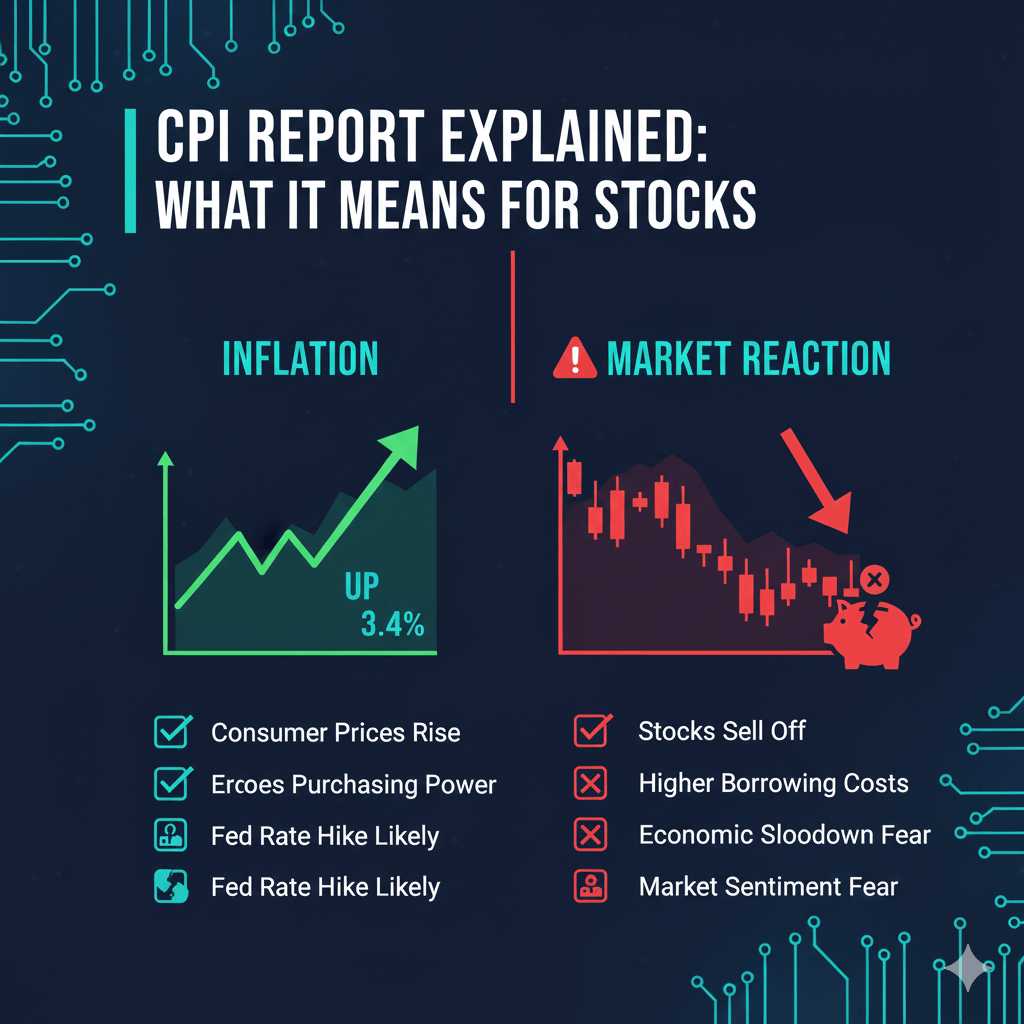
Stocks react to CPI reports primarily through expectations about interest rates. When CPI comes in higher than expected, markets often anticipate tighter monetary policy. When CPI is lower, markets may expect easing.
This mechanism explains why stocks sometimes fall on strong CPI data and rise on weaker data. The reaction is not about inflation itself, but about what it implies for future policy and valuations.
How CPI affects different sectors
CPI does not affect all stocks equally. Companies with strong pricing power may pass higher costs to consumers, protecting margins. Firms with thin margins may struggle.
Interest rate–sensitive sectors often react strongly to CPI changes. Consumer-focused businesses may be affected by changes in household purchasing power.
Understanding sector differences helps investors interpret CPI-driven market moves more clearly.
CPI report explained for dummies: a simple summary
For beginners, a simplified explanation helps. CPI measures how much everyday prices are changing. Rising CPI means higher inflation. Higher inflation often leads to higher interest rates. Higher rates usually pressure stocks.
This simplified chain captures the core relationship, even though real-world outcomes are more nuanced.
CPI and long-term stock returns
Over long periods, stocks have historically provided returns above inflation. However, periods of high or volatile inflation have often been challenging for markets.
Stable, predictable inflation tends to be easier for businesses and investors to manage. Sudden spikes or persistent high inflation increase uncertainty and risk.
Long-term investors monitor CPI trends rather than reacting to individual reports.
CPI versus other inflation measures
CPI is not the only inflation measure, but it is the most widely followed. Other measures may focus on different baskets or exclude volatile items.
Understanding CPI’s scope and limitations helps investors use it appropriately rather than treating it as a perfect measure.
CPI data and investor expectations
Markets move based on expectations. A CPI report that matches expectations may produce little reaction. A surprise reading can cause sharp moves.
This expectation-driven behavior explains why context is critical when interpreting CPI data.
Common misunderstandings about CPI
One common misunderstanding is that CPI reflects individual experience perfectly. In reality, CPI is an average. Individual households may experience higher or lower inflation.
Another misunderstanding is that any CPI increase is bad for stocks. Moderate inflation can coexist with strong markets.
Recognizing these nuances leads to better decision-making.
CPI and advertising cost confusion clarified
The term CPI is sometimes confused with advertising metrics such as cost per install. In economics and investing, CPI refers strictly to the consumer price index, not advertising billing models.
Separating these meanings avoids confusion when researching inflation.
Using CPI reports in an investment framework
Investors use CPI reports as one input among many. They combine CPI data with earnings trends, employment data, and central bank communication.
This balanced approach prevents overreaction to any single report.
Long-term perspective on CPI and markets
CPI reports are important, but they are part of a broader economic picture. Over time, markets adapt to inflation trends.
Understanding CPI helps investors stay informed without becoming reactive.
Conclusion: what CPI reports mean for stocks
CPI Report Explained shows that CPI influences stocks through costs, consumer behavior, and interest rates. Rising CPI can pressure markets, while easing CPI can provide relief.
By understanding how CPI is calculated, what current CPI represents, and how markets interpret CPI data, investors can better understand stock market reactions and make more informed decisions.