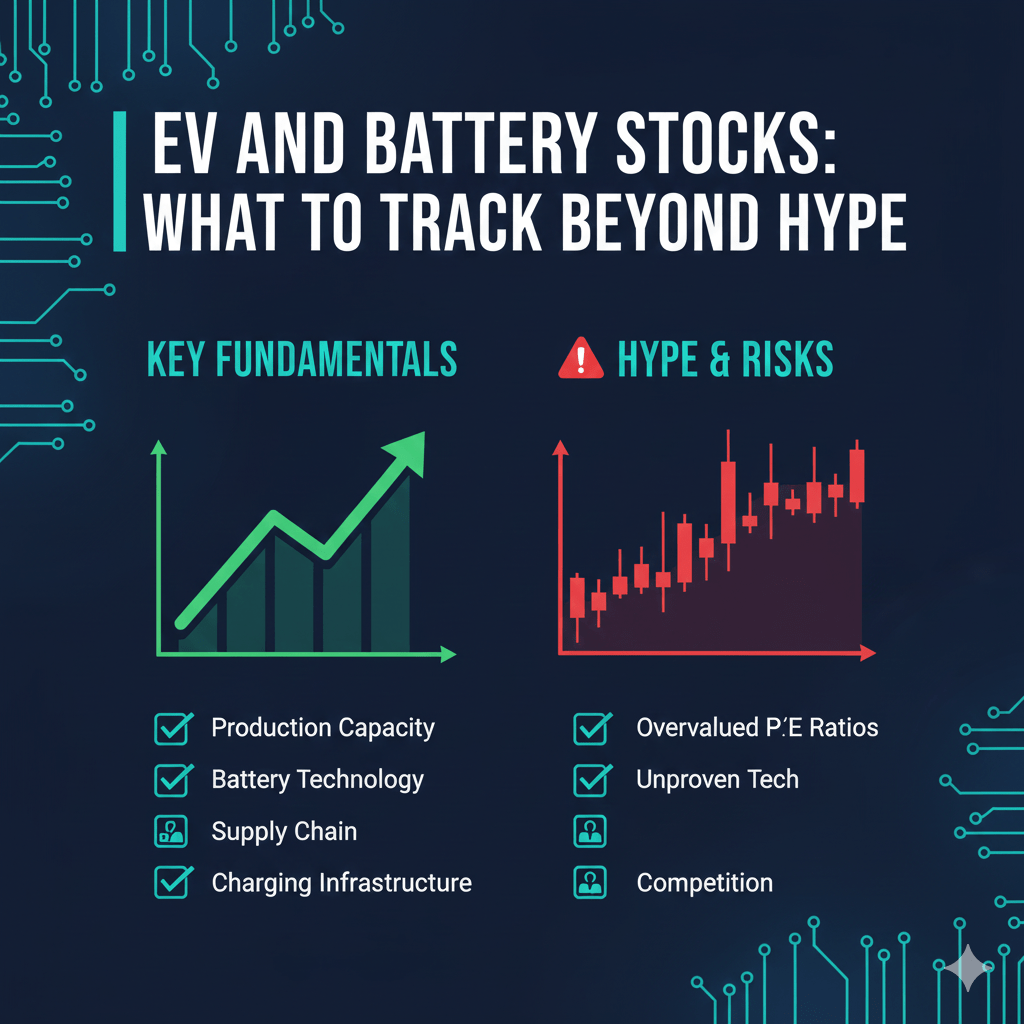
EV and Battery Stocks: What to Track Beyond Hype
EV and Battery Stocks pull in two kinds of investors at the same time. One group is drawn to the long-term story: transport electrification, grid storage growth, cheaper batteries, and new manufacturing capacity. The other group is drawn to the short-term excitement: a breakthrough chemistry headline, a viral “solid state battery stock” rumor, or a sudden spike in “EV battery penny stocks.” Both mindsets exist in the same market, which is why this theme can feel noisy.
The noise is avoidable. If you learn what to track, EV and Battery Stocks become easier to judge. You stop reacting to hype and start watching the indicators that move revenue, margins, and cash flow. You also get better at separating “battery technology stocks” with real adoption pathways from story-driven names that live on hopes.
This is educational content, not personal financial advice.
The value chain behind EV and Battery Stocks
Most people treat battery stocks as one category. In reality, the value chain has multiple profit pools, and they behave differently when demand rises or slows.
A clean way to map EV and Battery Stocks is through six buckets: raw materials and mining, refining and processing, cell manufacturing, pack and system integration, recycling, and end-market integrators (vehicle makers and energy storage developers). Each bucket has its own risk profile. A lithium project can benefit from rising metal prices even when EV demand is flat. A cell manufacturer can struggle during overcapacity even when EV adoption is still climbing.
If you want a simple mental model, think in inputs and outputs. Materials flow into cells. Cells become packs. Packs go into cars or storage systems. At end of life, recycling pushes materials back into the loop. Where a company sits in that flow determines what you should track.
Demand is not just EV sales anymore
A major shift in EV and Battery Stocks is that batteries are no longer only an EV story. Grid-scale storage has become a demand driver in its own right, pushed by renewables growth, grid constraints, and the need for flexible capacity.
That matters because grid storage has different economics than EV packs. The buyer cares about lifetime throughput, safety, and total installed cost more than peak energy density. This is why “battery storage stocks” can behave differently from EV-focused names, especially when stationary storage becomes the faster-growing segment in a given year.
So when you track EV and Battery Stocks, watch two demand curves, not one: EV batteries and energy storage batteries. A slowdown in one can be offset by strength in the other.
The cycle nobody wants to talk about: overcapacity and pricing pressure
If you’ve been around this theme for a while, you’ve seen it. Massive factory announcements happen during optimism, then pricing pressure hits, and suddenly everyone is searching for “best EV battery stocks” while the whole group sells off.
One of the most important “beyond hype” indicators is battery pack pricing. Falling pack prices are great for EV adoption and storage adoption, but they can squeeze margins for cell makers and pack suppliers unless they reduce costs even faster than prices fall.
Here’s the trap: revenue can still grow while profit shrinks. When the sector is fighting over utilization, companies may cut pricing to keep lines running, and margins compress quietly. That’s how “battery company stock” narratives break—growth continues, but the quality of that growth worsens.
Chemistry choices: LFP, NMC, and what they do to margins
Battery chemistry isn’t a side detail. It changes supply chains, raw material exposure, pricing power, and recycling economics.
LFP batteries often use cheaper inputs and are widely used in cost-sensitive EV segments and many storage projects. NMC batteries rely more on nickel and sometimes cobalt, which can change cost behavior and supply risk.
For EV and Battery Stocks, chemistry shifts matter because they change which upstream suppliers win, which cell makers have an advantage, and where pricing pressure lands. If a company’s edge is tied to a chemistry that becomes commoditized, margins can compress faster than investors expect.
A practical tracking habit is to follow chemistry mix in business updates. If a manufacturer is heavily exposed to one chemistry, you’ll want to understand whether that chemistry is gaining share, losing share, or becoming more price-competitive.
Solid state battery stock headlines: what to measure instead
“Solid state batteries stock” is searched so often because it sounds like the next leap. It also creates some of the loudest hype cycles.
Instead of chasing headlines like “quantumscape stock rise solid-state battery,” measure progress with grounded checkpoints:
Customer sample delivery and validation timelines
Manufacturing scalability and yield learning
Capex needs and factory readiness
Safety performance under real-world conditions
Cost pathway versus today’s mainstream chemistries
For best solid state battery stocks, the core risk is not whether the lab cell works. The risk is whether it can be manufactured at scale with acceptable yield, cost, and reliability.
That’s why a “best solid state battery stocks” list is less useful than a “milestones tracker.” If you can’t describe the next two milestones and the time window they sit in, you’re probably watching hype, not progress.
Sodium battery stocks and sodium-ion reality checks
“Sodium battery stocks” and “sodium ion battery stock” interest keeps rising because sodium-ion promises lower-cost inputs and can perform well in certain climates and use cases.
The smarter way to track “sodium ion battery companies stocks” is to focus on where sodium-ion is realistically competitive first: stationary storage, low-cost mobility, and specific temperature ranges. Then track commercialization timelines and customer pilots.
The biggest trap is assuming sodium will replace lithium broadly. It may complement lithium rather than replace it, depending on energy density needs and manufacturing scale.
Graphene battery stock and other “breakthrough” narratives
“Graphene battery stock” headlines appear because graphene is associated with strength, conductivity, and fast charging potential. The problem is that “graphene” can mean many different things in marketing language, and real commercial adoption is often unclear.
With breakthrough narratives, treat EV and Battery Stocks like a product business, not a science project. Ask:
Who is paying for it today?
What is the cost advantage at scale?
What is the manufacturing pathway?
What certifications are required?
How long is the customer qualification process?
If a company can’t point to realistic customer programs and a credible manufacturing plan, the stock often trades on excitement rather than business progress.
Battery technology stocks: the metrics that separate winners from story stocks
For EV and Battery Stocks, these are the metrics that matter most over time:
Cost curve progress: cost per kWh and how it’s achieved
Utilization: factories make money when lines run at scale
Yield and scrap rate: small improvements can change margins
Contract structure: fixed-price vs material pass-through
Customer concentration: one customer can move an entire quarter
Capex intensity: growth that requires endless capital can dilute owners
Working capital: inventory build can quietly eat cash
If you track these consistently, you’ll spot trouble earlier than investors who only track press releases.
Battery recycling stocks: economics, chemistry, and the LFP problem
“Battery recycling stocks” are often pitched as a guaranteed future. Recycling does have a strong logic: supply security, circular materials, and regulatory pressure. The catch is economics, which vary by chemistry and region.
Recycling profitability depends heavily on the value of recoverable materials. Lower-value chemistries can be harder to recycle profitably unless processes improve, scale grows, and collection logistics become more efficient.
If you’re evaluating “battery recycling stocks” or any recycling name, focus on feedstock access, processing yields, cost structure, and offtake agreements for recovered materials. Also understand the processing approach. Different methods have different energy and recovery profiles, which feed directly into margins.
The “beyond hype” point is simple: recycling is not one business model. It’s a set of models with very different economics.
EV battery manufacturing stocks: scale helps, but scale can also hurt
“EV battery manufacturing stocks” can look like the cleanest exposure to the theme, since cell makers sit near the center of demand. The core advantage is scale: bigger plants can reduce unit cost, and large contracts can provide volume visibility.
The core risk is also scale: when the industry builds too much capacity, pricing can fall, margins compress, and factories become underutilized. In that environment, even “best battery stocks” can disappoint because the market is fighting over volume.
A strong tracking habit is to watch the customer’s customer. A battery supplier’s risk is often determined by automaker demand decisions, model rollouts, and shifts in vehicle mix.
Lithium battery stocks and materials: the price exposure you’re really buying
“Lithium battery stocks” can mean cell makers, but it often points to miners and refiners. Materials exposure is powerful because materials can bottleneck supply. It’s also dangerous because commodity prices can fall even while long-term demand trends are positive.
For materials-linked names like “international battery metals stock,” “patriot battery metals stock,” “grid battery metals stock,” or “surge battery metals stock,” the biggest risks are timeline risk and funding risk. Early-stage projects can take years, and dilution can be heavy if capital markets tighten.
If your goal is value hunting, be careful applying that mindset here. A “cheap” materials name can stay cheap if the project’s path to production is unclear or if market pricing turns against it.
Freyr battery stock and the execution risk lesson
Many investors search “freyr battery stock,” “freyr battery stock price,” or “freyr battery stock prediction” expecting a straightforward EV battery production story. This is where it helps to remember that plans can change fast in this sector.
Battery companies can pivot strategies due to demand shifts, pricing pressure, funding realities, or policy changes. The larger lesson is execution risk: factories are expensive, timelines are long, and outcomes depend on consistent delivery.
If you’re tracking “freyr battery stock price today” or “freyr battery stock prediction,” the higher-value work is understanding the current business direction, how it affects future cash flow, and what milestones would confirm progress.
“Forever battery stock” and the viral rumor cycle
Search phrases like “forever battery stock,” “$3 forever battery stock,” and “forever battery stock price today” spread because they promise a simple story: one breakthrough, one cheap stock, one big payoff.
This theme is a magnet for rumor cycles. Your protection is simple: if a claim is built around a miracle battery and a secret ticker, slow down. Look for verifiable commercial milestones, manufacturing partners, and realistic timelines.
The market rewards real manufacturing and real contracts. It punishes fantasy timelines.
EV battery penny stocks: why they look tempting and why they’re dangerous
“EV battery penny stocks” and “best EV battery penny stocks” get attention because the upside feels huge. The downside is that small-cap battery names often combine multiple risks at once: early-stage tech, limited cash, uncertain customers, and thin liquidity.
If you explore “battery penny stocks,” keep position sizing conservative and be honest about what you’re buying. You’re often buying optionality, not stable cash flow.
A healthier approach is to treat penny names like venture bets: small allocation, milestone-based thinking, and a willingness to be wrong without it harming your overall plan.
EV and Battery Stocks outside the U.S.: Korea, India, and the global map
The theme is global, and “korea secondary battery stocks outlook 2025” searches reflect how important Korea remains in cell manufacturing and materials processing. Global customer decisions can impact suppliers quickly, which reinforces the need to watch utilization and contract stability.
In India, interest around local battery names reflects both legacy battery markets and newer lithium opportunities. The country’s EV adoption path and grid storage needs can create multiple demand pockets, though company exposure varies widely.
A simple global takeaway: EV and Battery Stocks are tied to regional industrial policy, local supply chains, and customer geography. That adds opportunity, and it adds trade and policy risk.
How to build a watchlist that stays useful
A useful watchlist for EV and Battery Stocks is balanced across the value chain so you can see where strength is forming and where weakness is spreading.
Include a few materials-linked names if you want commodity exposure, a few cell or pack manufacturers if you want volume exposure, a recycling name if you want circular economy exposure, and a storage-focused name if you believe grid demand is the next leg.
Then track the same indicators regularly: utilization, margins, capex, cash burn, customer concentration, and chemistry mix. This gives you a repeatable process, even when headlines are chaotic.
Conclusion
EV and Battery Stocks can reward patient investors, but only when you treat them like real businesses with cycles, costs, and competition. The clean way to move beyond hype is to track what drives outcomes: battery pack pricing and utilization, chemistry mix shifts like LFP vs NMC, the reality of solid-state and sodium-ion timelines, and the economics of battery recycling across different chemistries.
If you want to be consistently right more often than the crowd, stop hunting for the perfect headline and start building a simple tracking system. Over time, that discipline matters more than the next viral “battery technology stocks” story.