
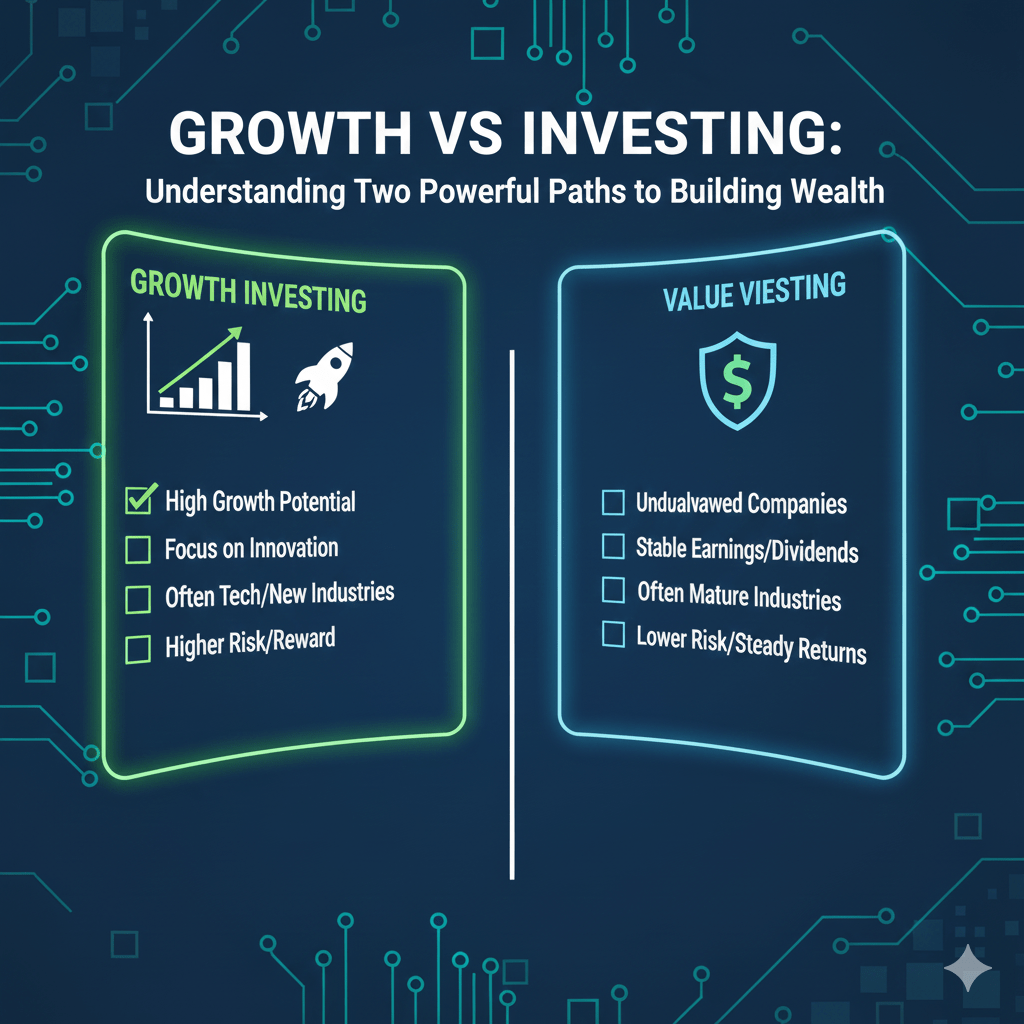
Growth vs Value Investing: Understanding Two Powerful Paths to Building Wealth
Few investing debates have lasted as long or generated as much discussion as growth vs value investing. From individual investors to institutional fund managers, opinions differ sharply on which approach delivers better results over time. Some investors favor rapid expansion and future potential, while others prefer stability, cash flow, and undervaluation. Both styles have produced success stories, and both have experienced long periods of underperformance.
Understanding growth vs value investing is not about choosing sides blindly. It is about recognizing how each strategy works, when it performs best, and how it fits different investor goals. This guide explains both approaches in depth, explores historical performance, and helps readers understand how to think about growth vs value investing for beginners as well as experienced investors navigating changing market cycles.
The Core Idea Behind Growth Investing
Growth investing focuses on companies expected to grow faster than the overall market. These businesses typically reinvest profits to expand operations, develop new products, or enter new markets. Investors buy growth stocks not for current income, but for the belief that earnings will rise significantly in the future.
Growth investors are often willing to pay higher prices for this potential. Valuation metrics may appear stretched compared to traditional benchmarks, but the expectation is that future earnings growth will justify the premium. This mindset explains why growth stocks often trade at higher multiples.
Growth vs value investing stocks differ fundamentally in how investors interpret risk and reward. Growth investors accept higher uncertainty today for the promise of stronger returns tomorrow.
The Philosophy of Value Investing
Value investing takes a different path. It focuses on companies that appear undervalued relative to their fundamentals. These businesses may be temporarily out of favor due to market conditions, short-term challenges, or overlooked potential.
Value investors look for strong balance sheets, stable earnings, and reasonable prices. Rather than paying for future growth, they seek a margin of safety. The belief is that markets eventually recognize true worth, allowing undervalued stocks to recover.
In growth vs value investing, value emphasizes patience and discipline. Returns often come from reversion to fair value rather than rapid expansion.
Growth vs Value Investing for Beginners: Choosing a Starting Point
For newcomers, growth vs value investing for beginners can feel overwhelming. Growth investing appears exciting, driven by innovation and momentum. Value investing feels conservative, grounded in financial discipline.
Beginners often gravitate toward growth stocks because they dominate headlines and discussions. However, value investing can provide emotional stability by reducing exposure to extreme price swings.
The best starting point depends on temperament. Investors who tolerate volatility may prefer growth, while those who value consistency may lean toward value. Understanding personal risk tolerance matters more than choosing the “right” style.
Growth vs Value Investing Chart: Visualizing the Difference
A growth vs value investing chart typically highlights how these styles perform across different economic periods. Growth stocks often outperform during periods of low interest rates and economic expansion. Value stocks tend to perform better during recoveries, inflationary environments, or rising rate cycles.
Charts also reveal long stretches where one style dominates the other. This reinforces an important lesson: neither strategy wins all the time. Performance rotates based on macroeconomic conditions.
Interpreting these charts helps investors manage expectations rather than chase recent performance.
How Growth vs Value Investing Stocks Differ in Practice
Growth vs value investing stocks differ in more than just valuation. Growth companies often reinvest earnings aggressively, resulting in lower dividends. Value companies are more likely to return cash to shareholders.
Growth stocks typically belong to industries driven by innovation and changing consumer behavior. Value stocks often operate in mature industries with steady demand.
These differences affect portfolio behavior. Growth portfolios may experience sharper swings, while value portfolios may offer smoother returns.
Growth vs Value Investing Stock Performance Over Time
Growth vs value stock performance has shifted across decades. There have been periods where growth stocks significantly outperformed, followed by periods where value regained leadership.
These shifts are influenced by interest rates, inflation expectations, and economic growth. When future earnings are discounted less heavily, growth becomes more attractive. When cash flow and tangible value matter more, value investing gains favor.
Understanding this cyclical nature prevents unrealistic expectations and reactive decisions.
Growth vs Value Investing 2021 as a Turning Point
Growth vs value investing 2021 stands out as a notable period in recent history. After years of growth dominance, value stocks began to regain attention as economic conditions shifted.
Rising inflation concerns and changing monetary policy altered investor priorities. Cash flow, profitability, and pricing power became more important. This shift reminded investors that leadership can change quickly.
While specific years should not drive long-term strategy, they illustrate how macro forces influence style performance.
The Role of Valuation in Growth vs Value Investing
Valuation plays a central role in this debate. Growth investors focus on future earnings potential, often accepting higher current valuations. Value investors focus on current fundamentals and discounted prices.
Neither approach is inherently superior. Overpaying for growth can reduce returns, just as buying cheap stocks with declining prospects can destroy value.
The challenge lies in distinguishing temporary mispricing from permanent impairment.
Value vs Blend vs Growth: Understanding the Spectrum
Investing styles do not exist in isolation. Value vs blend vs growth represents a spectrum rather than strict categories. Blend strategies include characteristics of both growth and value.
Some companies exhibit steady growth while maintaining reasonable valuations. These stocks appeal to investors who want balance rather than extremes.
Understanding this spectrum helps investors avoid rigid classifications and appreciate nuance.
Value vs Growth vs Core in Portfolio Construction
Value vs growth vs core strategies play different roles in portfolio construction. Core holdings aim to track the broader market, providing stability. Growth and value allocations add tilt based on investor preferences.
A well-constructed portfolio may include all three. This approach reduces reliance on any single style and smooths performance across cycles.
Diversification across styles can improve long-term consistency.
Growth vs Value Stocks Chart and Market Cycles
A growth vs value stocks chart often aligns closely with broader market cycles. During early economic recovery, value stocks may lead as earnings rebound. During expansion, growth stocks may take over as innovation accelerates.
Late-cycle environments often test both strategies, emphasizing quality and balance sheet strength. Understanding where the economy stands helps investors interpret style performance.
Charts offer perspective, not prediction.
Risk Profiles in Growth vs Value Investing
Risk manifests differently in growth vs value investing. Growth risk comes from unmet expectations. When growth slows, valuations can compress quickly. Value risk comes from structural decline. Cheap stocks may stay cheap if fundamentals deteriorate.
Recognizing these risks helps investors manage exposure. No strategy eliminates risk, but awareness reduces surprises.
Risk management matters as much as return potential.
Emotional Discipline and Style Investing
Growth vs value investing also tests emotional discipline. Growth investors may struggle during drawdowns when optimism fades. Value investors may lose patience when recovery takes longer than expected.
Staying committed to a chosen approach requires belief in the underlying logic, not short-term results. Emotional reactions often undermine otherwise sound strategies.
Consistency turns strategy into outcome.
How Institutional Investors View Growth vs Value Investing
Institutional investors often rotate between growth and value based on economic signals. They analyze interest rates, inflation trends, and earnings cycles to adjust allocations.
Retail investors can learn from this approach without copying it blindly. Understanding why institutions shift styles provides insight into broader market behavior.
Awareness improves strategic thinking.
Growth vs Value Investing in Long-Term Wealth Building
Over long horizons, both growth and value investing have created wealth. The key difference lies in the path taken. Growth investing often delivers higher peaks and deeper troughs. Value investing tends to compound steadily over time.
Long-term success depends more on staying invested than on perfect timing. Commitment to a strategy matters more than switching styles frequently.
Time rewards discipline.
Blending Growth and Value for Stability
Many investors choose not to pick sides. Blending growth and value provides exposure to innovation and stability simultaneously. This reduces reliance on any single economic outcome.
Blended portfolios may underperform during extreme rallies but often hold up better during downturns. For many investors, this trade-off is acceptable.
Balance supports resilience.
Common Mistakes in Growth vs Value Investing
One common mistake is chasing whichever style recently performed best. Another is misunderstanding why a stock is classified as growth or value.
Ignoring fundamentals in growth investing or ignoring change in value investing can lead to disappointment. Successful investors adapt without abandoning core principles.
Learning from mistakes strengthens strategy.
Choosing Between Growth vs Value Investing Based on Goals
Investment goals influence style choice. Younger investors with long horizons may favor growth. Investors seeking income or capital preservation may lean toward value.
There is no universal answer. Growth vs value investing is personal, shaped by time horizon, risk tolerance, and financial objectives.
Alignment creates confidence.
Conclusion: Growth vs Value Investing Is About Perspective, Not Prediction
Growth vs value investing is not a contest with a permanent winner. It is a framework for understanding how different types of companies perform under different conditions. Growth focuses on future potential, value focuses on present worth, and both rely on disciplined thinking.
Investors who understand these differences gain flexibility and clarity. Whether choosing one style or combining both, success comes from consistency, patience, and self-awareness. Markets will continue to change, but sound principles endure.