S&P 500 ETF vs Total Market ETF: Which Should You Pick?
Choosing between an S&P 500 ETF vs Total Market ETF looks like a big fork in the road, but most of the time it’s a small decision dressed up as a big one. Both are broad U.S. stock exposures. Both are typically low-cost. Both can sit at the center of a long-term portfolio.
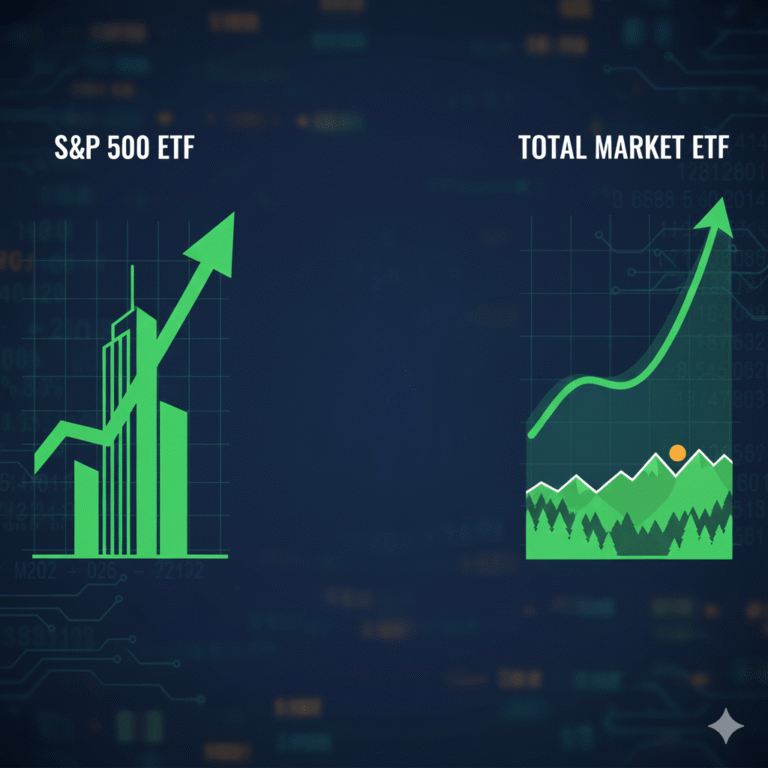
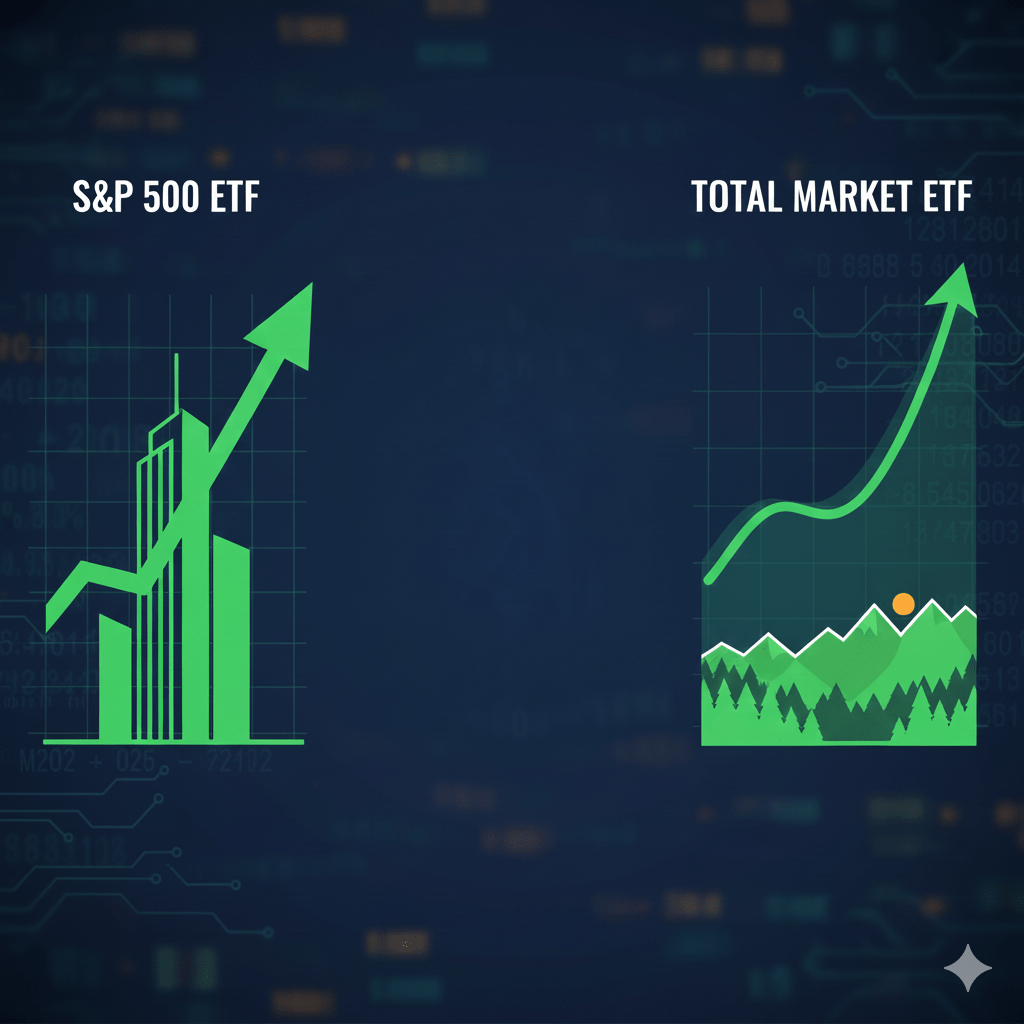
The real difference is what you want your “U.S. stocks” bucket to represent. An S&P 500 fund is a large-company lens on America. A total market fund is the whole U.S. equity picture, including mid-cap and small-cap companies. Because large caps dominate overall market value, the two often move and perform very similarly over long stretches. That’s why discussions like S&p 500 etf vs total market etf reddit and S&P 500 vs total market Reddit often end up in the same place: pick one, stay consistent, and don’t keep switching.
Still, there are reasons to prefer one over the other. This guide explains the differences that actually matter—coverage, concentration, volatility, and how each fund tends to behave across market cycles—so your choice feels simple and defensible.
The quick answer most investors need
If you want a single fund that represents “the U.S. stock market,” the total market option usually matches that intent better.
If you want a slightly simpler, large-cap-focused approach that already covers most of the U.S. market by value, the S&P 500 option is often enough for a core holding.
In the S&P 500 ETF vs Total Market ETF decision, there is no perfect pick. There is only the pick you can hold for years without constantly second-guessing.
What an S&P 500 ETF actually owns
An S&P 500 ETF tracks an index built around roughly 500 large U.S. companies. It is designed to represent the “large-cap heart” of the American stock market. These are usually the biggest, most established public businesses across sectors such as technology, healthcare, financials, consumer, industrials, and more.
The index is typically market-cap weighted, meaning larger companies carry more influence than smaller ones. That weighting approach is a major reason the S&P 500 can feel “top heavy” at times. When the biggest companies have strong years, the index can look unstoppable. When leadership rotates away from those names, the index can feel slower.
When you choose S&P 500 ETF vs Total Market ETF, you’re choosing whether your U.S. equity exposure stops at large caps or extends into everything else.
What a Total Market ETF actually owns
A total market ETF aims to hold most investable U.S. stocks—large, mid, and small. Instead of focusing only on large companies, it includes a much wider range of publicly traded businesses, often numbering in the thousands.
Because total market funds include large caps too, their biggest weights are often similar to an S&P 500 fund. The difference is the long tail: mid-cap and small-cap exposure is included automatically. That matters in certain parts of the market cycle and can slightly change volatility, returns, and diversification characteristics.
This is the main “coverage” difference in S&P 500 ETF vs Total Market ETF. One is large-cap only; the other is “large-cap plus the rest.”
Why Total stock market vs S&P 500 performance charts look so similar
If you’ve ever looked at a Total stock market vs S&P 500 performance chart, you probably noticed they track each other closely. That’s not a coincidence.
Large U.S. companies represent the majority of total U.S. market value. Even in a total market fund, large caps still dominate the overall portfolio because the fund weights holdings by size. So the same large companies often drive a big portion of returns in both funds.
That’s why, in the S&P 500 ETF vs Total Market ETF comparison, the performance gap is usually small over long stretches. The gap grows mainly when small and mid caps have a strong cycle (or a weak one).
Diversification: what you gain and what you don’t
The diversification story in S&P 500 ETF vs Total Market ETF is straightforward:
An S&P 500 ETF gives you diversification across sectors, but it stays inside large-cap territory. A total market ETF adds more companies, more sizes, and more business types—especially smaller firms that can behave differently during certain phases of economic expansion, tightening, and recovery.
The extra diversification is real, but it isn’t a guarantee of higher returns. Mid-cap and small-cap exposure can help when the market broadens out, and it can also hurt when smaller companies struggle more than large ones. Think of it as a “built-in style mix,” not a performance promise.
Volatility and drawdowns: the “smooth ride” idea
A common view is that an S&P 500 fund can feel smoother because large companies tend to be more established and liquid. There’s some truth to that. Smaller stocks often swing more, and they can drop harder in stressed markets.
But the difference is usually modest. Since both funds share the same large-cap core, their major drawdowns often look similar. If the broad U.S. market drops, both tend to drop.
If your decision is mainly about avoiding volatility, the bigger lever is not S&P 500 ETF vs Total Market ETF—it’s your overall stock allocation and whether you hold stabilizers such as cash reserves or bonds.
The small-cap and mid-cap “slice” inside the total market
The total market’s extra exposure comes from mid and small companies. Sometimes that matters a lot.
When smaller companies have a strong run, total market funds can have a modest tailwind compared to the S&P 500. When large caps dominate and small caps lag, the S&P 500 can edge ahead. That back-and-forth is why the debate stays alive.
The cleanest way to understand S&P 500 ETF vs Total Market ETF is to ask: do you want that small and mid-cap exposure automatically included all the time?
Concentration risk: “500 stocks” can still be top heavy
People hear “500 companies” and assume the S&P 500 is evenly spread. It isn’t. Market-cap weighting means the top companies can represent a large share of the index’s movement.
That’s not necessarily bad. It simply means your results are tied closely to the leadership of the biggest U.S. businesses. When those companies are thriving, the index can be strong. When leadership changes, concentration can become noticeable.
Total market funds are also market-cap weighted, so they can be top heavy too. The difference is the long tail: thousands of smaller positions that contribute more when the market’s gains broaden out.
In S&P 500 ETF vs Total Market ETF, concentration is one of the few structural differences you can actually feel during leadership shifts.
“VTSAX vs S&P 500 graph” and what it usually proves
When people compare VTSAX vs S&P 500 graph, the goal is usually to decide which one “wins.” A more useful takeaway is what the comparison tends to show in practice: the paths are close, and differences are cyclical.
In many time windows, the two look almost identical because the same mega-cap companies dominate both. When smaller companies outperform, the total market approach can look better. When large caps lead, the S&P 500 approach can look better.
So the graph is less about a final verdict and more about understanding that leadership rotates.
Vanguard versions: what “S&P 500 vs total market” often means
When someone searches S&p 500 etf vs total market etf vanguard or Growth etfs vs growth stocks vanguard in other contexts, they usually mean they want a simple, mainstream solution. Often the comparison comes down to a popular S&P 500 ETF versus a popular total market ETF.
The practical decision is still the same: do you want large-cap-only exposure as your core, or do you want large-cap plus mid and small as your default?
For many investors, S&P 500 ETF vs Total Market ETF is not about squeezing out an extra fraction of performance. It’s about picking a core that matches how they think about “owning the U.S. market.”
Performance: what “wins” depends on the cycle
If you track S&p 500 etf vs total market etf performance across different periods, you will see the lead swap back and forth. Sometimes large caps dominate for years. Sometimes smaller companies go through strong stretches.
This is exactly why “pick the one that outperformed recently” often backfires. Market leadership rotates, and the last winner is not guaranteed to be the next winner.
The practical lesson in S&P 500 ETF vs Total Market ETF is to choose the one that matches your philosophy and then stay with it long enough for that philosophy to matter.
The Bogleheads view: why the debate never ends
In conversations like Total stock market vs S&P 500 Bogleheads, the same themes repeat because both sides are reasonable.
The total market camp argues: if you want “the market,” own the whole market.
The S&P 500 camp argues: the S&P 500 already represents most of the market by value, it’s simple, and it has a long history as a core holding.
Both views can be defensible. That’s why S&P 500 ETF vs Total Market ETF is often more about preference and consistency than about finding a single “correct” answer.
Overlap: why owning both often feels redundant
Many investors consider owning both. The overlap is substantial because the S&P 500 is a large portion of any total market fund.
Holding both is not automatically wrong, but it can create unnecessary complexity if your goal is simply broad U.S. exposure. Most of the time, holding both is effectively a small tilt toward large caps while still owning the broader market.
If you do hold both, do it intentionally. In S&P 500 ETF vs Total Market ETF, accidental overlap is one of the most common ways a portfolio becomes messier than it needs to be.
When the S&P 500 choice is usually reasonable
The S&P 500 side of S&P 500 ETF vs Total Market ETF often makes sense when:
You want a clean large-cap core and don’t care about owning every smaller public company.
Your retirement plan or employer options offer an S&P 500 fund as the most practical low-cost U.S. stock choice.
You want slightly fewer moving parts and prefer a “large-company heavy” profile.
The key is not pretending it’s the entire market. It’s a large-cap representation of it.
When the total market choice is usually reasonable
The total market side of S&P 500 ETF vs Total Market ETF often makes sense when:
You want a single U.S. stock fund that includes large, mid, and small companies automatically.
You do not want to think about adding a separate small-cap fund later.
You like the idea of owning the entire investable U.S. equity universe in one simple holding.
If your investing approach is “broad, simple, complete,” total market fits naturally.
A simple decision test that avoids regret
If you’re stuck between S&P 500 ETF vs Total Market ETF, answer these two questions:
Do you want your U.S. stock fund to represent “big U.S. companies” or “the entire U.S. market”?
Do you plan to add separate small-cap exposure later?
If you want one fund and you want completeness, total market is the clean answer.
If you prefer large-cap simplicity and you do not want extra small-cap exposure, S&P 500 is fine.
The biggest risk is not the fund—it’s switching
Across S&P 500 ETF vs Total Market ETF debates, the most damaging pattern is switching after one side has a hot run.
Performance chasing often leads to buying the winner late and selling the laggard right before it rebounds. That behavior can turn two excellent index choices into a frustrating experience.
Pick your lane, stick to a contribution plan, and let time do the work.
Conclusion
The S&P 500 ETF vs Total Market ETF choice is a classic “small difference, big emotions” decision. The S&P 500 option gives you a large-cap lens on the U.S. market. The total market option gives you the entire investable U.S. stock market, including mid-cap and small-cap exposure.
Performance is often close, and leadership rotates. That’s why the smarter focus is coverage preference and consistency. If you want “the whole market,” choose total market. If you want “large-cap core,” choose S&P 500. Either can be a strong long-term foundation when you hold it through full market cycles.